Commercial Aluminium Cladding
Commercial ACP and aluminium cladding install in Ghana: corporate and retail façades fabricated and fitted by the install trade — with honest PE vs FR vs A2 fire-core disclosure (EN 13501-1) and execution to EN 1090. Aluminium Installers Ghana, since 1988.
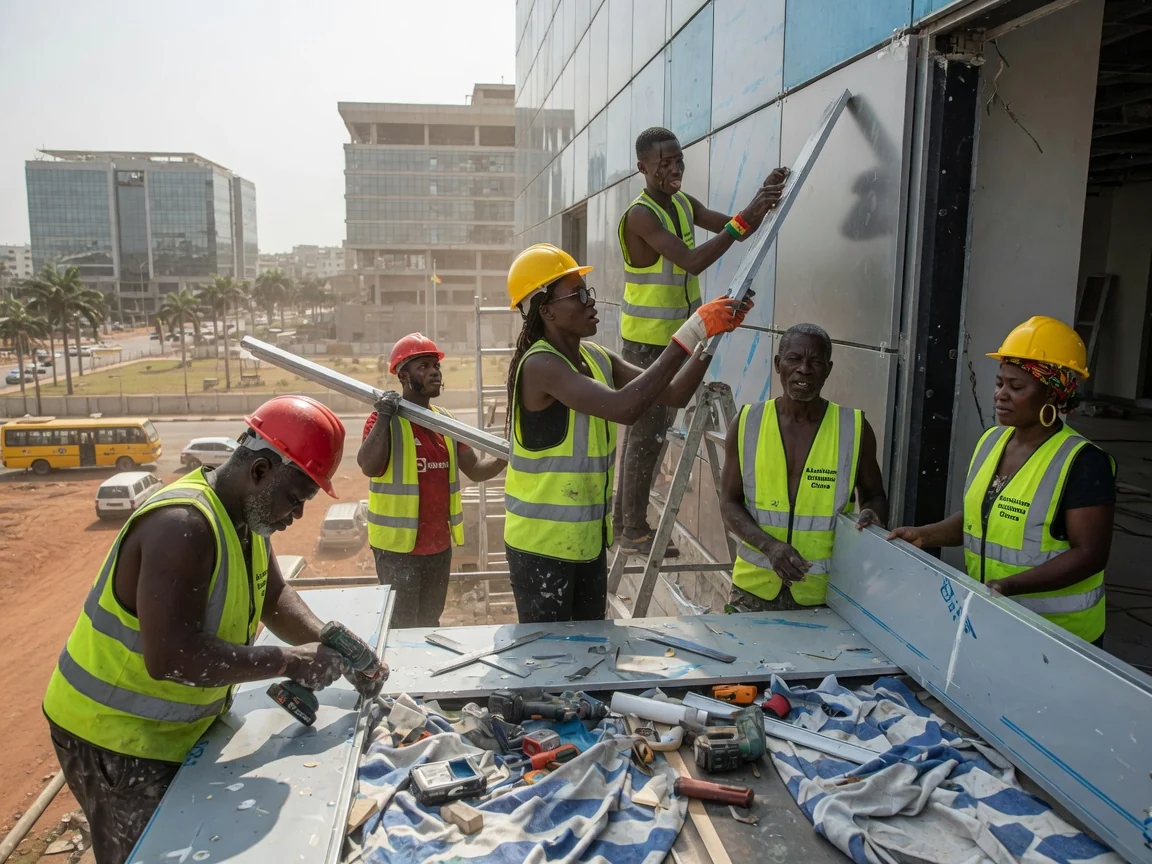
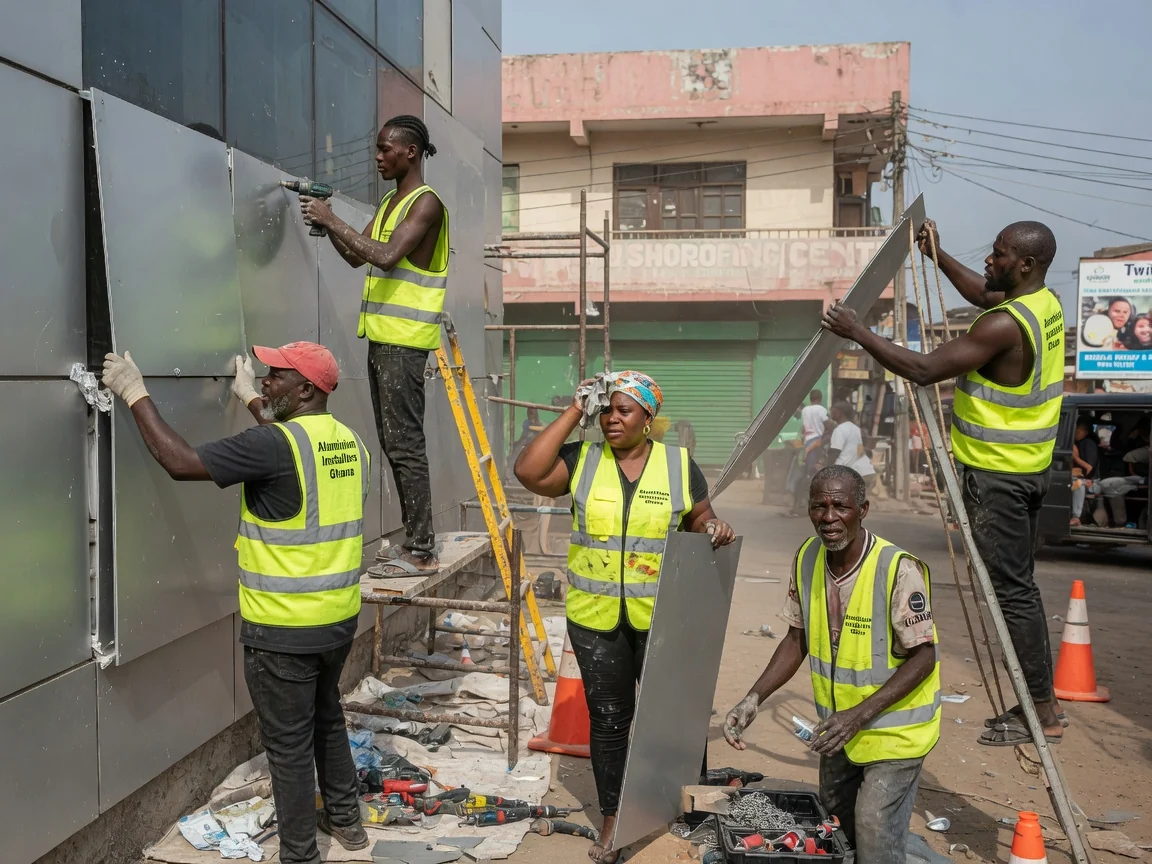
Commercial aluminium cladding is the façade skin fitted to corporate and retail buildings — most often aluminium composite panel (ACP/ACM), sometimes solid or perforated aluminium — fabricated into cassettes and fixed to an aluminium sub-frame over a ventilated cavity. It is what gives a building a clean, modern, low-maintenance face, and as the install trade we fabricate and fit both the panels and the system behind them. Aluminium Installers Ghana has fabricated and installed aluminium façades across Ghana since 1988, and our position on cladding is the one this market keeps avoiding: we tell you what core is in the panel.
Why the Panel Core Is the Decision Behind the Finish
Two cladding façades can look identical and behave completely differently in a fire, because the aluminium skins are the same and only the core changes. A combustible PE (polyethylene) core — the material involved in the Grenfell Tower fire — can turn a façade into a fire path. A mineral-filled A2 core barely contributes to a fire. The Ghana market routinely sells “ACP” without ever naming the core, and the cheapest quote is usually an undisclosed PE panel. Choosing the core is a life-safety decision made against the building’s height, use and occupancy — not a finish or a price decision — and it is the part of cladding we put in writing.
Choosing a Commercial Cladding System
The right system depends on the building, its height and occupancy, and whether the panel core has to meet a fire class. The configurations below cover most corporate and retail work in Ghana, and we specify to the building rather than to the lowest disclosed price.
Commercial Cladding Systems We Install
ACP Cassette Rainscreen (Ventilated Façade)
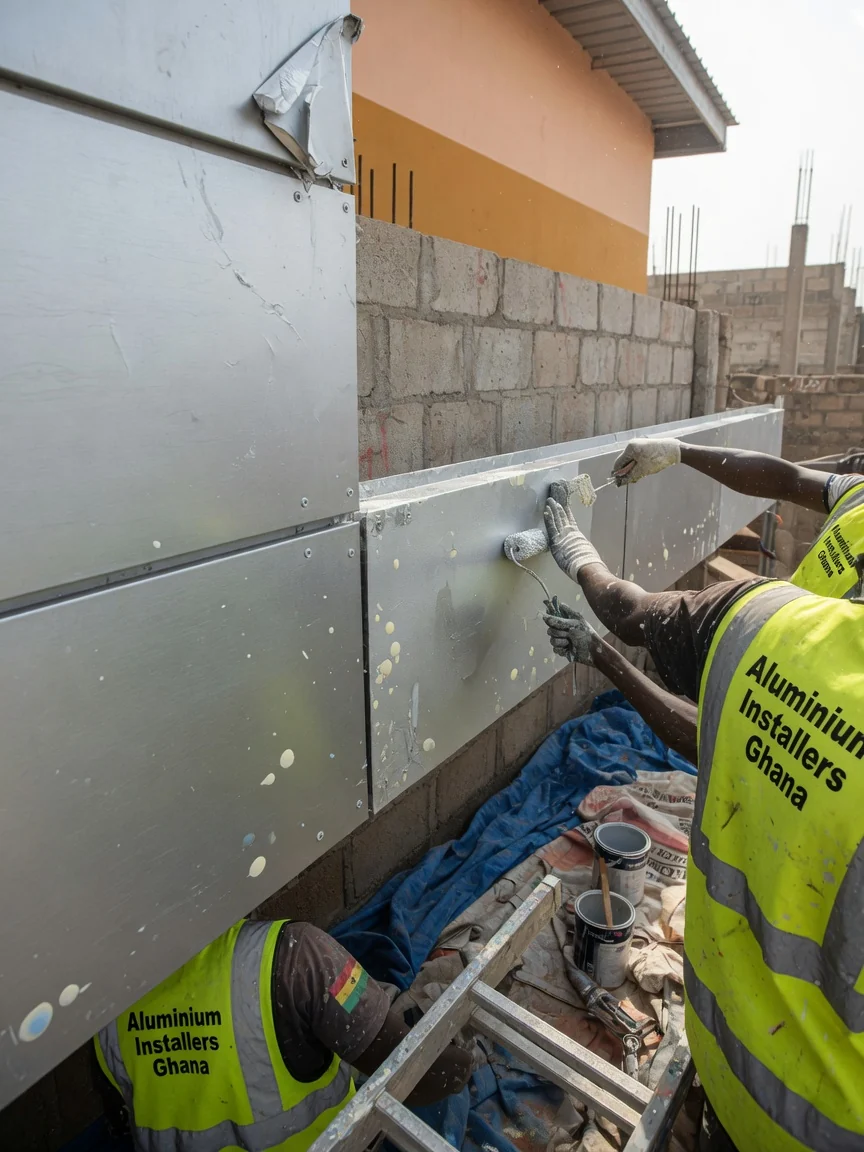
Aluminium composite panels routed and folded into cassettes, fixed to an aluminium sub-frame over a ventilated cavity — the standard corporate and retail façade. The core (PE / FR / A2) is specified to the building’s fire requirement and named in writing.
Solid & Perforated Aluminium Cladding
Solid aluminium sheet or perforated aluminium screens for façades, soffits and feature panels where a single-material aluminium skin (no composite core) is wanted — including perforated brise-soleil-style screening for solar shading and visual articulation.
Re-Cladding & Combustible-Panel Replacement
Surveying an existing façade and replacing combustible PE-core panels with FR or A2 cores, with the cavity, cavity barriers and fixings detailed correctly — handing over the new EN 13501-1 evidence for what is now on the wall.
The Three ACP Cores Compared
| Core | Composition | Fire behaviour | EN 13501-1 (typical) | Specify for |
|---|---|---|---|---|
| PE | 100% polyethylene | Combustible (Grenfell core) | Fails A2 | Not for tall/occupied façades |
| FR | ~70% mineral filler | Fire-retardant | B-s1,d0 (typ.) | Mid-rise where B-class permitted |
| A2 | >90% mineral filler | Limited combustibility | A2-s1,d0 | High-rise, hospitals, institutional |
(Classifications are typical; the actual class is per the specific panel’s certification, which we provide in writing.)
How We Fabricate & Install a Cladding Façade
- Survey, set out and confirm the panel and core — panel grid set out; ACP core (PE/FR/A2) and EN 13501-1 class confirmed in writing.
- Fabricate panels and sub-frame to EN 1090 — panels routed and folded into cassettes; aluminium sub-frame, cavity and fixings detailed.
- Install the system, not just the panels — sub-frame, ventilated cavity, cavity barriers where required, and fixings fitted as a system.
- Inspect and hand over the paper trail — line, level and seal inspected; panel data sheets and fire class handed to the owner.
Materials & Real Standards
- EN 13501-1 — reaction-to-fire classification of the panel core (Euroclass A1, A2, B… with s = smoke and d = droplet sub-classes); A2-s1,d0 is the target for non-combustible ACP, named honestly per the panel’s certificate
- ACP cores — PE (combustible, the Grenfell core), FR (~70% mineral filler, fire-retardant), A2 (>90% mineral filler, limited combustibility) — we disclose which one is fitted
- EN 1090 — execution of aluminium structures (EN 1090-1 conformity/CE; EN 1090-3 aluminium; Execution Classes EXC1–4) governing the sub-frame and panel fabrication
- Coatings — PVDF, PE or FEVE finish specified for weathering and colour retention (a finish decision, separate from the fire question)
- Panel format — typical ACP sheet 1220×2440mm in 3–6mm; aluminium alloy, gauge and finish to the specification
What Affects the Cost
- The panel and core specified (PE vs FR vs A2 — the fire-rated cores cost more, and are worth it where the building requires them)
- Panel thickness (3–6mm), coating (PVDF/PE/FEVE), alloy and finish (mill, anodised, RAL/Pantone)
- The sub-frame, ventilated cavity detailing, and cavity barriers
- Façade area, building height, and access (which drive rigging and programme)
Commercial cladding is quoted on survey — panel grade, height and access decide the figure, and large façades are genuinely an on-survey job. As an indicative material reference only, loose ACP sheet is sold in this market from around GH₵315 per 3mm sheet and imported ACP runs roughly US$2–8/m² as material alone — figures that exclude the sub-frame, fabrication, fixings and install, which is the bulk of an installed façade. We never quote on the word “cheap” — the cheapest cladding quote is usually an undisclosed PE core.
Applications Across Ghana
- Corporate and bank HQ façades in Airport City, Ridge and the CBD
- Retail, showroom and mall frontages across Greater Accra and Tema
- Perforated aluminium screening and feature panels for solar shading and articulation
- Re-cladding and façade refurbishment replacing combustible PE panels with FR or A2 cores
- Commercial and institutional cladding projects in Kumasi and Takoradi
Areas We Serve
Aluminium Installers Ghana fabricates and installs commercial cladding across Greater Accra — Airport City, Ridge, Cantonments, the CBD, Osu, East Legon, and Tema — plus Kumasi and Takoradi.
Related Services
- Façade Engineering — performance-tested envelope engineering
- Curtain Wall Installation — stick and unitised curtain walling
- Structural Glazing Systems — silicone-bonded frameless glass
- Aluminium Window Systems — windows fabricated and installed
- CNC & Laser Aluminium — precision-cut and perforated aluminium
- Specialty Fabrication — bespoke aluminium fabrication
- Louvres & Brise-Soleil — solar-shading louvre systems
- 10-Year Aluminium Warranty — written warranty programme
- Aluminium Windows Cost (Ghana) — material vs installed pricing
- Façade Engineering — whole-envelope performance
Frequently Asked Questions
What is commercial aluminium cladding? The rainscreen or façade skin fitted to corporate and retail buildings — most often aluminium composite panel (ACP/ACM), sometimes solid or perforated aluminium — fabricated into cassettes and fixed to an aluminium sub-frame over a ventilated cavity. We fabricate and fit the panels and the system behind them.
Is the cladding fire-safe — what core is in the panel? For ACP the core decides it. PE is combustible (the Grenfell material); FR is fire-retardant (~70% mineral filler); A2 is limited-combustibility (A2-s1,d0) under EN 13501-1, the highest ACP rating. We name the core and its EN 13501-1 class in the specification and hand over the panel data sheet.
How long does a commercial cladding installation take? It depends on façade area, panel system, building height and access. A small retail frontage is short; a corporate tower re-clad is a phased, rigged project. We give a programme at survey alongside the quotation.
Can you re-clad an existing building or replace combustible panels? Yes. Replacing combustible PE-core panels with FR or A2 cores is core cladding work. We confirm the new panel and its EN 13501-1 class, install with the cavity and barriers detailed correctly, and hand over the evidence.